Re-reading

It’s an odd temporal tumbling, re-reading a book you read a long time ago. I usually can hardly remember the names of the characters, let alone the plot, but however distant it feels, a novel always leaves me with either a small number of particular moments vividly recalled, or (more usually) a general atmosphere: a way of thinking or being or a particular logic for things unfolding.
Over the last couple of months, I re-read two books I originally read a long time ago but had – in all meaningful senses of the word – forgotten.
The first was EM Forster’s Howards End (1910). Just before Christmas I had dinner at my friend Laurence’s and he said it was his favourite book – he said it was ‘the perfect book’ – so I went back to it. Here is my copy.
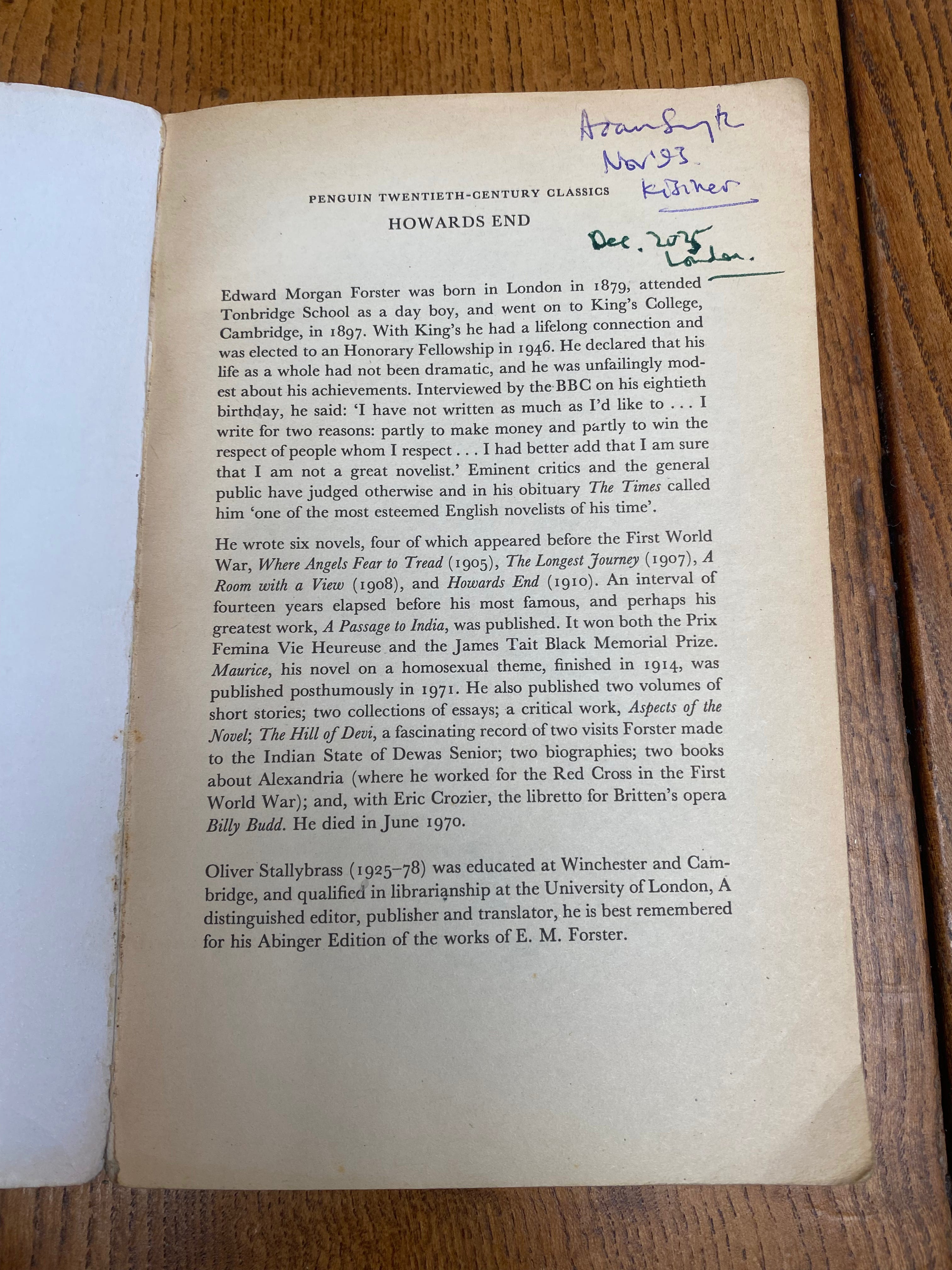
I read it first in November 1993 in Kishinev (now Chișinău), Moldova. I was 21 and was teaching English to children and adults at a physically crumbling school; Moldova had only separated from the Soviet Union two years before. The people I met were divided fairly evenly between pro Russia and pro Europe. You could only change a dollar at a time because the currency was collapsing so fast. I was living with a Moldovan family in a tower block in the middle of the capital. At midday, the father would come back from his lawyer’s office to have lunch with me: we’d eat borscht and bread and butter, and talk in elementary French, and the expectation was that we’d finish between us the bottle of vodka he brought. My afternoon teaching was chaotic. But I was also reading EM Forster.
When I reread Howards End 29 years later – this was December 2025, just after Laurence’s dinner – there was only one bit I remembered: the part where younger brother Tibby, at a performance of Beethoven’s 5th symphony (in chapter 5), ‘implored the company to look out for the transitional passage on the drum.’ I remembered this word for word – ‘the transitional passage on the drum’ – and also as a mood: a sense of wanting others to be alert to an imminent significance, and those others not taking notice.
After Howard’s End I re-read Jane Austen’s Emma. My copy of Emma takes me further back: it’s my school copy and so we’re in A-level English with Mr Batten at Dr Challoner’s Grammar School in Amersham, and it’s 1988:
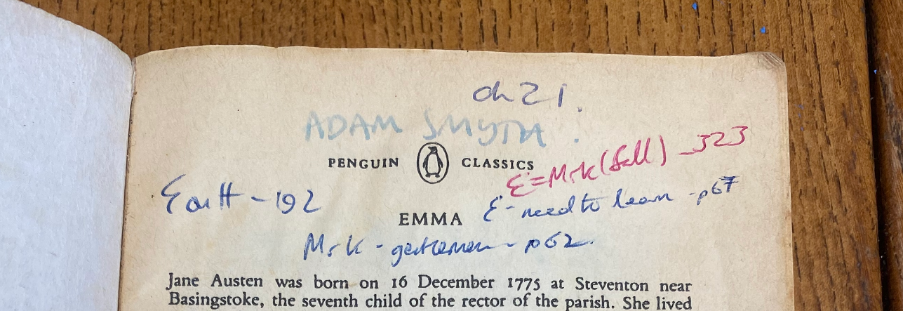
I was good at English, even if I never said a word (my teenage mode was to strive for invisibility above all things). The only trace I left on the book was a series of underlinings and a few summarising words. Things like this:
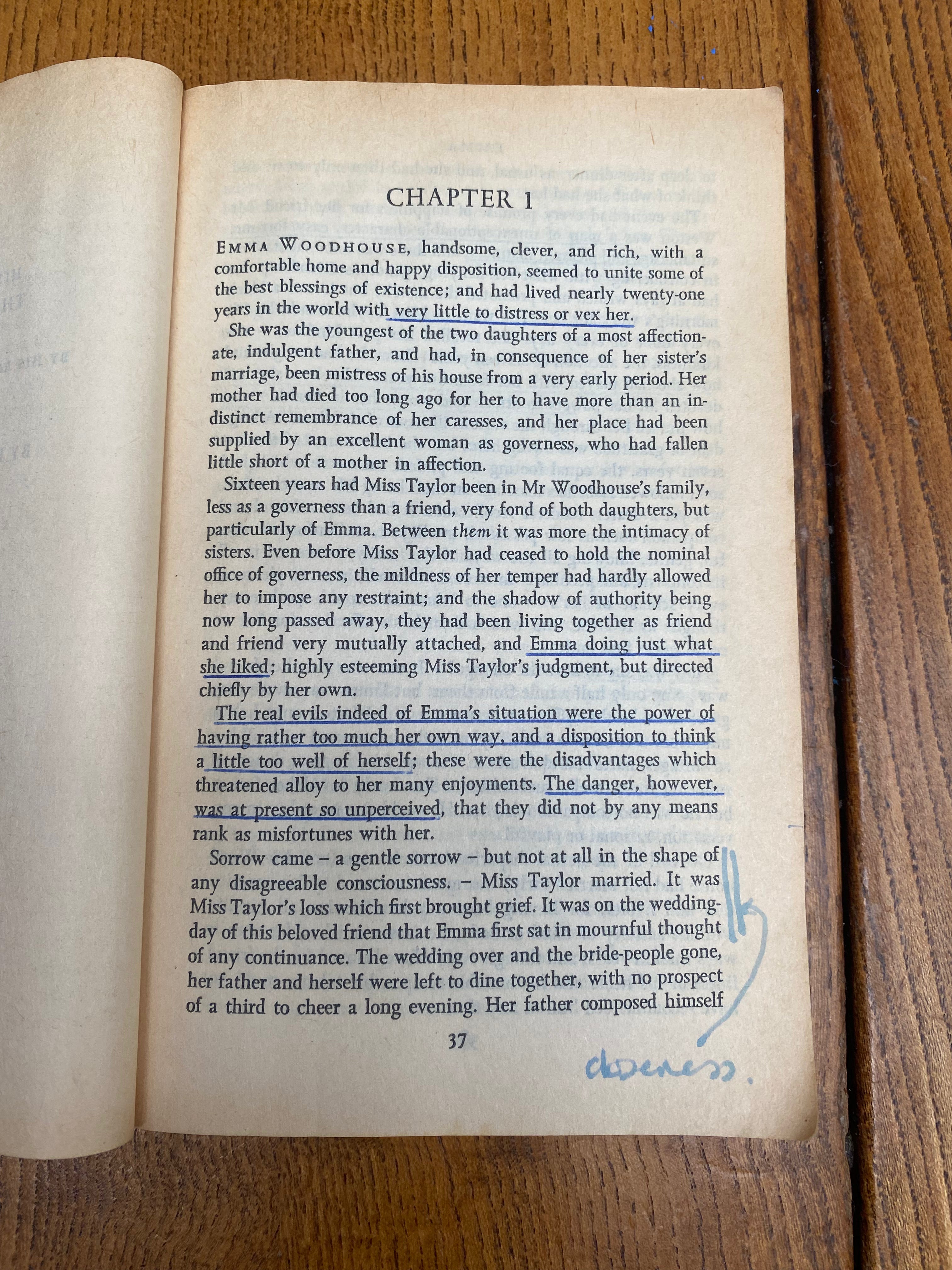
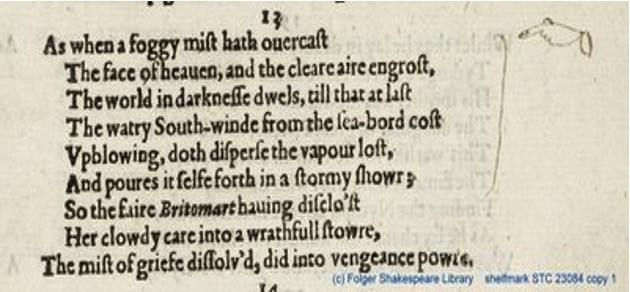
I like the way I’ve added ‘closeness’ to the description of Miss Taylor. It makes me think how distant these markings are, and how distant I am. I’ve no idea what I was thinking; why underline ‘Emma doing just what she liked’, and not any number of other clauses? I find the neatness of the underlinings sad, and I feel a long way away – as far away as this unknown reader, adding a pointing fist (or ‘manicule’) to a copy of Edmund Spenser’s The Fairie Queene (1615) now in the Folger Library (to be exact: STC 23084 Copy 1).
And here is Ben Jonson – friend-rival of Shakespeare (‘I loved the man,’ Jonson wrote, ‘this side [of] idolatry’) – annotating the great how-to poetry manual of sixteenth-century verse, George Puttenham’s Art of English Poesy (1589) (this one is British Library G.11548):
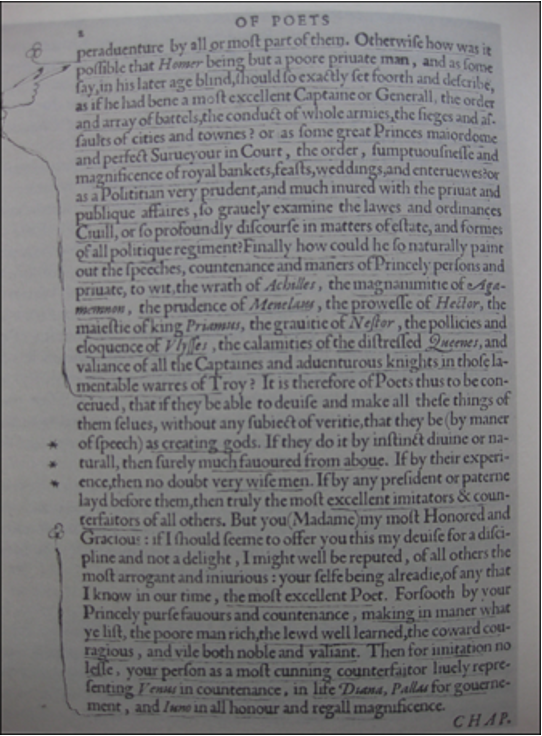
What does it mean to underline a clause? To add as asterix? Is it endorsement? Interest? Disagreement? Here is the awkward 16-year-old me, diligently using a ruler to underline some of Austen’s clauses (and adding at the bottom of the page: ‘PHYSICAL APPEARANCE IMP[ORTANT]’):
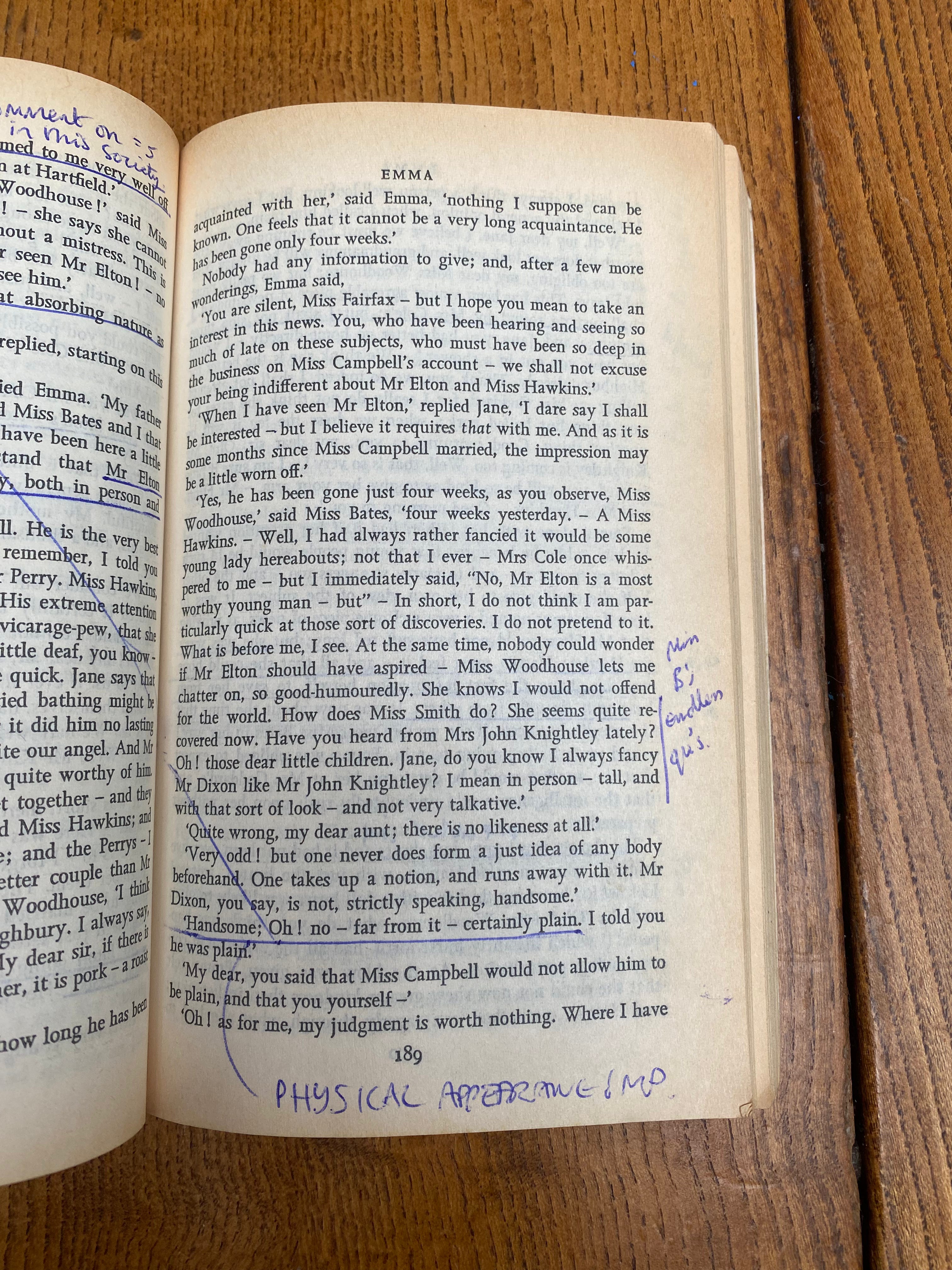
‘Reading itself is such an inscrutable activity’ — Jeff Dolven and Sean Keilen wrote in 2010 – ‘and to watch someone read is to be forcefully reminded of everything we cannot know about another mind.’
It’s uncanny how often you say what I’ve been thinking. Re-read (ok, skimmed) an Austen novel in January that hadn’t been opened for three decades. My teenaged handwriting touched and saddened me. So neat. And the naive enthusiasm for my discovery of IRONY on every page!!!
Heh, this is a post guaranteed to flush out the librarians among your readers -- Helen Barrell's comment could be mine, word for word (except for "we were allowed to take the novels into exams" -- what??). I recall my college library, like many others, used to have a Cabinet of Shame, containing books withdrawn from the shelves because of the copious annotations.
I, too, came across some of my own annotations to school and university texts recently, and ended up contemplating a back-garden auto-da-fé... They tended towards AMAZING!!, WHAAT?, and the occasional FAR OUT! (the language of literary analysis was different in 1972).